
Nuts and Bolts of Poker
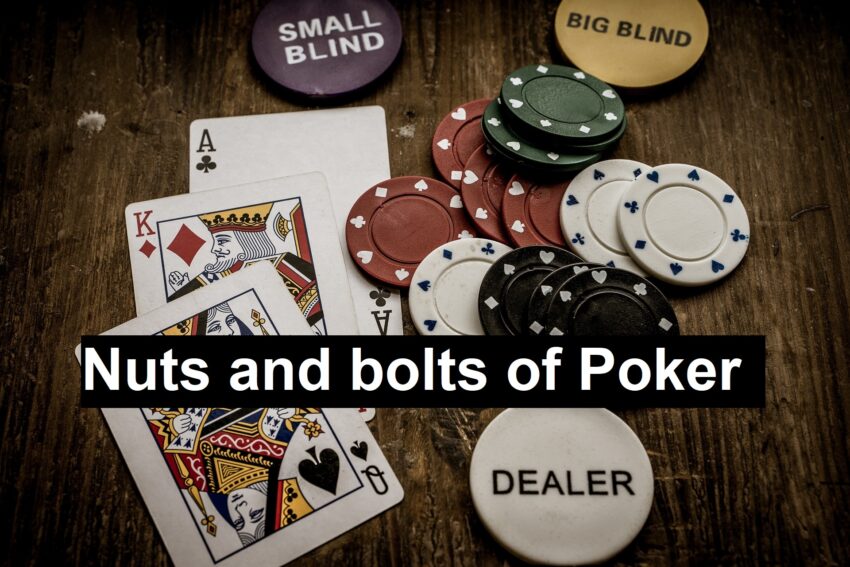
As early as the sixteenth century, Germans played a feigning diversion called “Pochen.” It afterward created into a French form, called “Poque,” which was in the long run brought over to Modern Orleans and played on the riverboats that utilized the Mississippi.
In the 1830s, the diversion was refined encourage and got to be known as Poker. Amid the Gracious War, the key run the show almost drawing cards to move forward one’s hand was included. A variety – Stud Poker – showed up at approximately the same time. There are hundreds of forms of Poker, and the amusement is played not as it were in private homes, but too in incalculable Poker rooms at popular casinos. Poker can be played socially for pennies or matchsticks, or professionally for thousands of dollars.
There is bounty of good fortune in Poker, but the amusement requires inconceivably awesome expertise as well, and each player is the ace of his possess fate.
The Pack
The standard 52-card pack, some of the time with the expansion of one or two jokers, is utilized. Poker is a one-pack amusement, but nowadays, in essentially all recreations played in clubs and among the best players, two packs of differentiating colors are utilized in arrange to speed up the amusement. Whereas one pack is being managed, the other is being rearranged and arranged for the following bargain. The strategy for two packs is as takes after: Whereas the bargain is in advance, the past merchant amasses all the cards from the pack he managed, rearranges them, and places them to the cleared out. When it is time for the another bargain, the rearranged deck is passed to the another merchant. In numerous recreations in which two packs are utilized, the dealer’s left-hand adversary, instep of the right-hand adversary, cuts the pack.
In clubs, it is standard to alter cards regularly and to allow any player to call for unused cards at whatever point they wish. When modern cards are presented, both packs are supplanted, and the seal and cellophane wrapping on the unused decks ought to be broken in full see of all the players.
Card Values/scoring
While Poker is played in multitudinous shapes, a player who gets it the values of the Poker hands and the standards of wagering can play without trouble in any sort of Poker diversion. But in a few forms of the amusement, a Poker hand comprises of five cards. The different combinations of Poker hands rank from five of a kind (the most elevated) to no combine or nothing (the lowest):
Five of a Kind – This is the most noteworthy conceivable hand and can happen as it were in diversions where at slightest one card is wild, such as a joker, the two one-eyed jacks, or the four deuces. Cases of five of a kind would be four 10s and a wild card or two rulers and three wild cards.
Straight Flush – This is the most noteworthy conceivable hand when as it were the standard pack is utilized, and there are no wild cards. A straight flush comprises of five cards of the same suit in grouping, such as 10, 9, 8, 7, 6 of hearts. The highest-ranking straight flush is the A, K, Q, J, and 10 of one suit, and this combination has a extraordinary title: a regal flush or a illustrious straight flush. The chances on being managed this hand are 1 in nearly 650,000.
Four of a Kind – This is the another most noteworthy hand, and it positions fair underneath a straight flush. An case is four experts or four 3s. It does not matter what the fifth, unmatched card is.
Full House – This colorful hand is made up of three cards of one rank and two cards of another rank, such as three 8s and two 4s, or three experts and two 6s.
Flush – Five cards, all of the same suit, but not all in arrangement, is a flush. An case is Q, 10, 7, 6, and 2 of clubs.
Straight – Five cards in grouping, but not all of the same suit is a straight. An case is 9♥, 8♣, 7♠, 6♦, 5♥.
Three of a Kind – This combination contains three cards of the same rank, and the other two cards each of a diverse rank, such as three jacks, a seven, and a four.
Two Sets – This hand contains a combine of one rank and another combine of a diverse rank, furthermore any fifth card of a diverse rank, such as Q, Q, 7, 7, 4.
One Combine – This visit combination contains fair one match with the other three cards being of diverse rank. An illustration is 10, 10, K, 4, 3.
No Match – This exceptionally common hand contains “nothing.” None of the five cards combine up, nor are all five cards of the same suit or continuous in rank. When more than one player has no match, the hands are evaluated by the most noteworthy card each hand contains, so that an ace-high hand beats a king-high hand, and so on.
Two hands that are indistinguishable, card for card, are tied since the suits have no relative rank in Poker. In such a case, the tied players part the pot. Note that if two hands contain the same tall combine, at that point the positioning of the following card in the hands decides which one wins. For illustration: 9, 9, 7, 4, 2 beats 9, 9, 5, 3, 2. Moreover, two hands that have indistinguishable sets would be chosen by the fifth card. For illustration: Q, Q, 6, 6, J beats Q, Q, 6, 6, 10.
Betting
Betting is the key to Poker, for the diversion, in pith, is a diversion of chip management. In the course of each Poker bargain, there will be one or more wagering interims in which the players have an opportunity to wagered on their hands. Minimizing misfortunes with destitute hands and maximizing rewards with great hands is the fundamental aptitude that Poker requires.
Before the cards are indeed managed, the rules of the Poker diversion being played may require that each player put an starting commitment, called an “stake,” of one or more chips into the pot, to begin it off.
Each wagering interim, or circular, starts when a player, in turn, makes a wagered of one or more chips. Each player to the cleared out, in turn, must either “call” that wagered by putting into the pot the same number of chips; or “raise,” which implies that the player puts in more than sufficient chips to call; or “drop” (“overlap”), which implies that the player puts no chips in the pot, disposes of their hand, and is out of the wagering until the another deal.
When a player drops, they lose any chips that have put into that pot. Unless a player is willing to put into the pot at slightest as numerous chips as any going before player, they must drop out.
A wagering interim closes when the wagers have been equalized – that is, when each player has either put in precisely as numerous chips as their forerunners or has dropped. There are more often than not two or more wagering interims for each Poker bargain. After the last interim there is a “confrontation,” which implies that each player who remains appears their hand confront up on the table. The best Poker hand at that point takes the pot.
If a player makes a wagered or a raise that no other player calls, they win the pot without appearing their hand. In this way, in Poker, there is a feigning component, and the best combination of cards does not continuously win the pot! Feigning is one of the key reasons why Poker is so popular.
If a player wishes to stay in the amusement without wagering, they “check.” This implies, in impact, that the player is making a “wagered of nothing.” A player may check given no one some time recently them in that wagering interim has made a wagered. If another player has wagered, they cannot check but must at slightest call the wagered or drop. A player who checks may raise a wagered that has been raised by another player. This is called “sandbagging,” which is permitted, unless it has been chosen in advance that this hone is illegal. If all players check amid a circular of play, the wagering interim is over, and all the players still in the pot stay in the game.
In each wagering circular, one player is assigned as the to begin with bettor, agreeing to the rules of the diversion. The turn to wagered continuously moves to the cleared out, from player to player, and no one may check, wagered, or indeed drop, but when it is their turn.
Knowing When to Bet
The positioning of Poker hands is based on science. The less likely a player is to get a certain hand, the higher it positions and the more likely it is to win the pot. For case, a player ought to not anticipate to be managed a straight flush more than once in 65,000 hands, but they can anticipate to be managed two combine around once in each 21 hands.
Unless a player is arranging to feign, they ought to not make a wagered without holding a hand that they think may be the best. No Poker player can wagered scholarly people unless they know what constitutes a great hand, a reasonable hand, and a terrible hand. A table of the different Poker hands and the number of combinations of each in a pack of cards is provided.
The Kitty
By consistent or larger part assention, the players may build up a extraordinary support called a “kitty.” Ordinarily the kitty is built up by “cutting” (taking) one low-denomination chip from each pot in which there is more than one raise. The kitty has a place to all the players similarly, and it is utilized to pay for unused decks of cards or for nourishment and drinks. Any chips cleared out in the kitty when the diversion closes are partitioned similarly among the players who are still in the amusement. Not at all like the run the show in a few other recreations, such as Pinochle, when a player takes off a Poker diversion some time recently it closes, they are not entitled to take their share of chips that comprised portion of the kitty.
Chips
Poker is nearly continuously played with poker chips. For a amusement with seven or more players, there ought to be a supply of at slightest 200 chips. Ordinarily, the white chip (or the lightest-colored chip) is the unit, or lowest-valued chip, worth anything the least stake or wagered is; a ruddy chip (or a few other colored chip) is worth five whites, and a blue chip (or a few other dark-colored chip) is worth 10 or 20 or 25 whites or two, four or five reds. At the begin of the amusement, each player “buys in” by obtaining a certain number of chips. All of the players ordinarily purchase in for the same amount.
Banker
One player ought to be assigned as the financier, who keeps the stock of chips and records how numerous have been issued to each player or how much cash the player has paid for their chips. Players ought to make no private exchanges or trades among themselves; a player with excess chips may return them to the investor and get credit or cash for them, whereas a player who needs more chips ought to get them as it were from the banker.
Betting Limits
There are diverse ways of settling a wagering constrain. A few constrain is fundamental; something else a player with a part more cash would have, or would be seen to have, an out of line advantage. Once settled,